Every structure rests on soil or rock. Yet soil investigation is often the first budget line to be cut, with fewer boreholes, shallower depths and the lowest quote chosen. The savings are small. The cost of designing on poor data shows up later as over-designed foundations, cracked structures, settlement, or a redesign in the middle of construction.
What soil investigation tells the designer
- What is under the site: the layers of soil and rock, and how deep each one goes
- How strong the ground is: shear strength and bearing capacity
- How much it will settle: consolidation behaviour under the new load
- Groundwater: its level and any chemicals that attack concrete and steel
- Special risks: expansive clays that swell, loose sands that can liquefy in an earthquake, and soft soils that need improvement
Where poor data costs money
- Over-design: without reliable data, designers use cautious assumptions, so foundations and piles become bigger and deeper than needed.
- Under-design: a weak layer that was missed leads to settlement, cracks or failure.
- Delays: surprises found during excavation stop the work while the design is changed.
- Disputes: when ground conditions differ from the report, claims and arguments follow.
Reliable data that represents the real site reduces the overall project cost.
What a good investigation includes
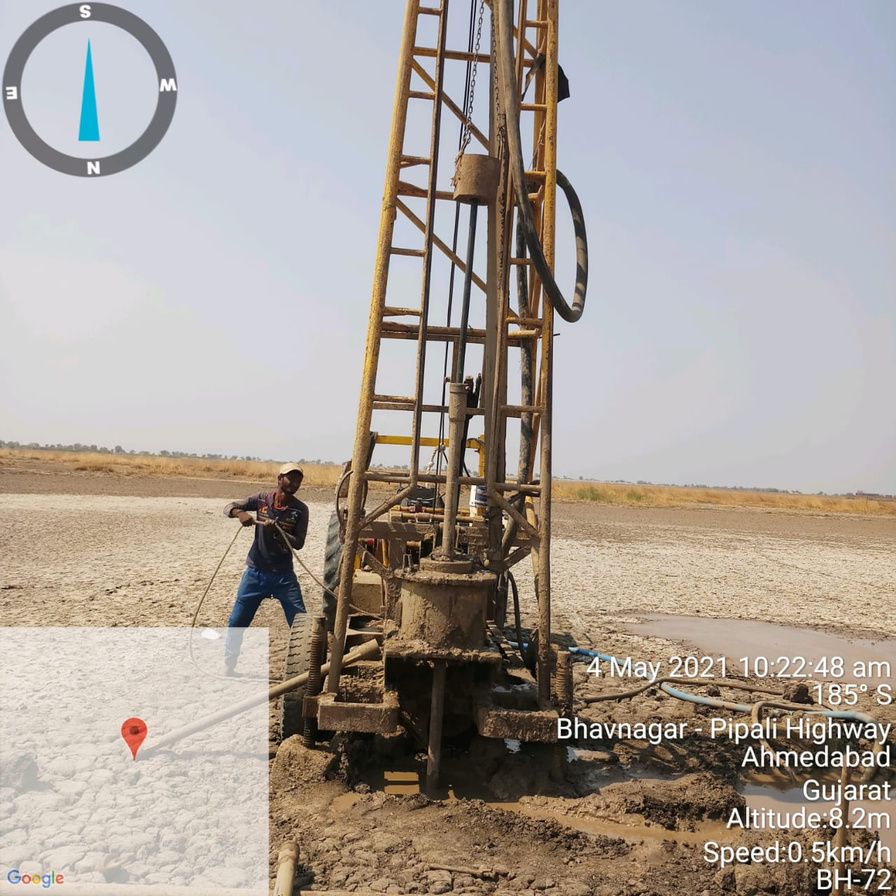
- Boreholes at the right spacing and depth for the structure and its loads
- Standard penetration tests (SPT) at regular intervals
- Undisturbed samples (UDS) for strength and consolidation tests
- Rock coring with core recovery and RQD where rock is found
- Laboratory tests to the relevant Indian Standards: index properties, shear strength, consolidation, compaction and CBR, swelling, permeability, rock strength and chemical tests
- An interpretive report with clear recommendations: bearing capacity, settlement, pile capacity and liquefaction where needed
Why a design consultant should run your investigation
At C-Phi Consult we design every day, so we know what data a design needs and our reports give it. Our work is led by an IIT geotechnical engineer with 18+ years in the industry. When the soil turns out to be a problem, you get the solution from the same team, with no wait for an outside expert.
Our laboratory in Ahmedabad tests soil and rock samples. Our sister company, C-Phi Drilltech LLP, drills boreholes up to 300 m deep.
Plan the investigation before the design
Tell us the structure, the loads and the site location. We'll plan the number and depth of boreholes and the tests needed, and send a scope and a quote.
“RE wall” is a trademark of the Reinforced Earth Company. We use “RE wall / RS wall” because both terms are widely used for reinforced soil walls.